[Published: Friday November 20 2026]
 American Doctor: What Gaza's doctors taught their US colleagues about medicine, humanity and survival
By Sebastian Shehadi
LONDON, 20 Nov. - (ANA) - On 18 March 2025, Dr Feroze Sidhwa was at the Nasser Medical Complex in Khan Younis when Israel broke the ceasefire in Gaza, and the wounded began pouring in.
At the front of the hospital, a Palestinian surgeon in his mid-thirties was running triage – "the hardest job in a mass casualty event" – sending the dead to the morgue and the wounded on to the wards.
About 45 minutes in, his father-in-law's body was brought to him. "He stood aside for 30 or 40 seconds, said a little prayer," says Dr Feroze, an American trauma surgeon. "And then went back to work for another 11 or 12 hours, until he could go pray over his grave."
He then adds, "That taught me that I don't have any excuse for not doing what I can."
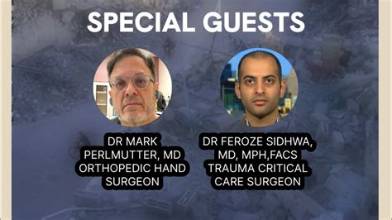
Dr Feroze is one of three US doctors in American Doctor, Poh Si Teng's documentary, which opens in UK cinemas on 20 November. The others are Mark Perlmutter, a Jewish orthopaedic surgeon, and Thaer Ahmad, a Palestinian-American emergency physician in Chicago.
Shot partly by a Palestinian crew, the film moves between Nasser's wards and Capitol Hill, where the doctors lobby Congress on behalf of Gaza's patients and medics.
All three volunteered in Gaza in 2024. Today, two are barred. Israel has denied Dr Thaer entry five times since, he says, most recently in August; while Dr Feroze was blocked in November 2025
However, Feroze has not given up on getting back. After being refused entry to Gaza, he travelled to Israel, gave talks at Ben-Gurion and Tel Aviv universities, and joined a petition to Israel's High Court of Justice challenging Israel's refusal to let medical volunteers like him into Gaza. It is due to be heard in December.
Both Feroze and Thaer came home changed by the Palestinian doctors they worked alongside.
Feroze is frank that Western surgical training is more robust in the science of disease. But Gaza's surgeons have an experience few Westerners can match, gained with almost nothing to work with.
"My job as a trauma surgeon is mostly to stop people from bleeding to death," he tells The New Arab.
"The speed at which they operate is really, really impressive, and they managed to do this without being reckless."
Watching them, he thought: "Maybe I can do that too."
Thaer, who has spent more than 15 years in global health and humanitarian medicine, was struck by something else: how his colleagues treated patients amid bombing, displacement and hunger, with "the sound of drones and fighter jets piercing the sky."
If a patient lay exposed, staff grabbed whatever they could to cover them. If a child called out for their mother or father, they found words to comfort them.
"I work in Chicago at a very busy trauma centre," he tells The New Arab.
"We don't have that same degree of composure under stress that comes nowhere close to the heights of the stress that they deal with."
His Palestinian colleagues also taught him something darker.
Thaer admits he had not grasped the extent to which Gaza's health system "was deliberately targeted and attacked, hospital by hospital," as the Israeli military moved in systematically.
By October 2025, more than 1,700 health workers had been killed in Gaza, according to its health ministry, a figure cited by the UN's humanitarian office.
On 12 November, an Israeli strike hit Nasser's surgical department, killing six people, among them Dr Rizk Abu Shaira, a Palestinian surgeon who appears in American Doctor and worked alongside Dr Feroze.
It was the seventh time the hospital had been struck since Israel's genocidal war began.
Feroze has put what he saw on the record, giving testimony to legal groups feeding evidence to the International Criminal Court and the International Court of Justice — under his own name, "unblinded to both the prosecutor and the defence."
"So we'll see if anything ever comes of that," he says.
At home, Dr Thaer says speaking out has come at a price.
"There are many people who have lost their jobs as a result of their advocacy on Palestine, as well as have been doxxed, have been harassed," he explains.
An assistant clinical professor, he has had several grand rounds – lectures key to academic promotion – cancelled "quite shortly after being scheduled as a result of complaints," often from people who "remain anonymous" and "do not know anything about me or how I practise."
He sees it as a tactic "to prevent the genocide from entering the consciousness of the American medical professional world."
Asked for their fondest memory of Gaza, both reach for moments of ordinary life. For Thaer, it is a plate of beans shared with local staff, single nurses talking about wanting to get married, others about one day travelling abroad for tourism.
"I look back at that, and I cherish that moment," he tells The New Arab.
Feroze's memories of his patients come with a grim caveat. "There are plenty of people in Gaza who are alive because of me," he says. "They may not be alive now."
The one he returns to is a nine-year-old girl, Jouri, who arrived in septic shock, so sick that her brain was no longer working properly.
After four or five days of treatment, she came back to herself – and realised her father, who had watched her slowly dying in a corner of the ward, would do anything she asked.
Before each return to the operating theatre, she bargained: no more surgery without melon slices, her favourite, and phone calls with her siblings at another hospital.
There was no melon to be had in a famine, and the phone networks were wrecked. But her father would turn up with half a piece of chocolate — anything sweet.
"God only knows what he had to do to get this stuff," Feroze shares. "It was weird, and beautiful, to see a father get to be a father and a child get to be a child, even in this horrifying situation."
There were cameras everywhere in Gaza, and the doctors had mixed feelings about them. Feroze wanted the film's camera "switched off all the time" — not because it got in the way, but because being filmed felt "embarrassing and odd."
Did it change how he triaged? "No, absolutely not. If it did, I wouldn't have allowed the camera to be there," Feroze says.
Thaer sees them as a necessary intrusion: "If this was going to change, it could only change with increased awareness and outrage, and the only way to do that is to capture accurately what was happening."
Unlike the film's other two doctors, Feroze, a Zoroastrian of South Asian heritage, has no "parochial or tribal or ethnic" connection to Gaza. Thaer is Palestinian; Perlmutter, who is Jewish, sees the war being waged "in his name."
"I'm just an American," Feroze says, "and I see what my own government is using – it's taxing my labour and everybody else's labour – to commit these crimes abroad."
Most Americans, he says, oppose what their government is doing in Gaza, "but the policy can continue with no problem, because we just don't live in a society where democratic institutions actually function in the way that people usually conceive of them."
Yet he still believes in showing them.
"If people were actually shown what's going on," he says, "it would be 99.9 percent of people who are opposed to it."
American Doctor releases in UK cinemas on 20 November
Sebastian Shehadi is a freelance journalist and a contributing writer at the New Statesman. - (ANA) -
AB/ANA/20 November 2026 - - -
|