[Published: Saturday November 21 2026]
 The violence of inequality is fuelling Europe’s protests
By Tamam Abusalama
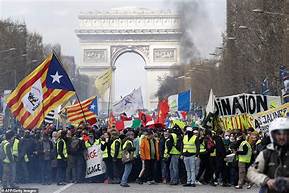
LONDON, 21 Nov. - (ANA) - For weeks, people across Europe, from France and Belgium to Spain and Albania, have filled the streets. They are protesting stagnant wages, soaring living costs, crumbling schools, climate injustice, and their governments’ complicity in war crimes and human rights violations.
On 11 November, Spain held its first general strike in 14 years. Unions called it over wages, housing and prices, and millions were expected to strike or demonstrate; authorities estimated that around 120,000 people marched in Madrid alone.
Following mass student protests that have swept France since mid-September, a national strike was held on 5 November, with more than 600,000 people joining rallies, according to the interior ministry. Trade unions also called for another day of action, which took place on 17 November.
In Brussels, around 50,000 people marched against austerity on 9 October, and another march is planned for 23 November.
At the edges of these mobilisations, some people have burned tyres, smashed shop windows and torn down signs.
Governments call it “chaos” and promise to restore “order.”
But whose order are they referring to? And who pays for it?
Naming the crisis
Long before the burning barricades reached our screens and social media feeds, another kind of violence existed: quieter, slower, and far less visible in mainstream media.
Schools are short of teachers, and classrooms are overcrowded, unsafe or falling apart. Families can no longer afford rising rents, food prices and energy bills. Public services are stretched so thin that dignity has become a privilege.
At the same time, for three years we’ve witnessed a genocide in Gaza live on our phones, while the EU and its member governments keep their political and economic ties with Israel intact, all while pretending to be concerned.
People did not invent this crisis. They simply stopped accepting it.
Indeed, violence is not inflicted only by the baton. It is also the over 2.6 million people experiencing homelessness and housing exclusion across OECD countries, including more than 1.4 million in the EU, in cities where homes stand empty. It is the 92.7 million people in the EU at risk of poverty or social exclusion, while governments find money for rearmament.
It is a heatwave that disproportionately kills the poor and the old while the rich wait it out in air-conditioning. At the end of June, EuroMOMO recorded 14,260 excess deaths across 24 European countries; more than 12,000 were among people aged 65 or over.
It is a division manufactured along lines of ethnicity, race, gender and sexuality. It is pushed through institutions like the European Parliament, which recently approved the EU’s new Return Regulation, expanding detention and deportation powers and creating a framework for “return hubs” in third countries.
It is war, occupation and dispossession, carried out, funded or excused by states that call themselves defenders of human rights and a “rules-based order.” Just look at the EU–Israel Association Agreement, which remains in force.
In 2025, EU–Israel trade in goods reached €43.3 billion. Meanwhile, the European Commission has presented the ReArm Europe plan, which aims to mobilise up to €800 billion for defence spending by 2030.
This violence is systemic. It lives in wages that do not cover rent, borders that decide who deserves safety, prisons that warehouse the poor and the racialised, hospitals that ration care by wealth, and housing markets that treat shelter as profit.
Distracting from the crisis
You’d be forgiven for thinking the recent uprisings sweeping Europe are just aimless looters looking to cause havoc, given the demonisation of the protests seen across mainstream media and heard in the rhetoric spewed by politicians. But this tactic, often used to further criminalise dissent and curtail civil liberties, has a long history.
Western states know all too well how to flip the accusation of ‘violence’ when people mobilise against inequality and injustice.
When the enslaved people of Saint-Domingue rose between 1791 and 1804, defeating French, Spanish and British forces, colonial powers called it barbarism. But the rebellion did not create the violence; it exposed it. The plantation system had chosen violence every day, in the whip, the market and the law.
In July 1995, more than 700 people died in Chicago during a week-long heatwave, most of them elderly, poor and Black. The heat was natural; the death toll was not. People died because they lacked air conditioning, safe housing and social support. Some lives had been protected. Others had been left to endure.
For decades, Palestinians have practised nearly every form of resistance against colonial violence. Whether it is mass marches, boycotts, appeals to international courts or armed resistance, they were branded by Israel and its allies as terrorism, barbarism and a threat to civilisation.
The same selective sight is enforced in Europe today. Protest crumbling schools and rising costs, and you are a threat to order. Let services deteriorate, inequality deepen, and police injure teenagers, and it is called policy, necessity or a regrettable incident.
Uprisings happen because of suffering and rage, not because the masses are living la vie en rose. Therefore, the act of taking on oppressive and repressive systems, especially in the face of aggressive policing, isn’t going to necessarily be pretty.
Protest movements are uncomfortable by nature. They disrupt comfort, unsettle privilege and drag into the open a harm so normalised it had become invisible. They will irritate precisely those who have the most to lose from change.
That discomfort is not proof that resistance has gone too far. It proves the status quo has finally been pushed to its limit and forced to explain itself.
Public anger is not where violence begins; it is structural violence’s delayed and visible consequence. And the powerful understand this.
We should refuse their vocabulary: a language in which a protest is violence and an eviction is policy; in which a shattered window is mourned, and a murder of a black teenager is an unfortunate incident.
The first violence is rarely the one that makes the news. Name it, and the question changes. It is no longer why people across Europe, particularly Gen Z, are angry. It is why anyone ever expected them to stay calm inside a system already at war with them.
Author
Tamam Abusalama is a Palestinian-Belgian communications professional, born and raised in the Jabalia Refugee Camp. She is currently leading the strategy for the European Citizens’ Initiative Justice for Palestine, which calls for the full suspension of the EU-Israel Association Agreement. - (ANA) -
AB/ANA/21 November 2026 - - -
|





 India/18 dead