[Published: Sunday November 08 2026]
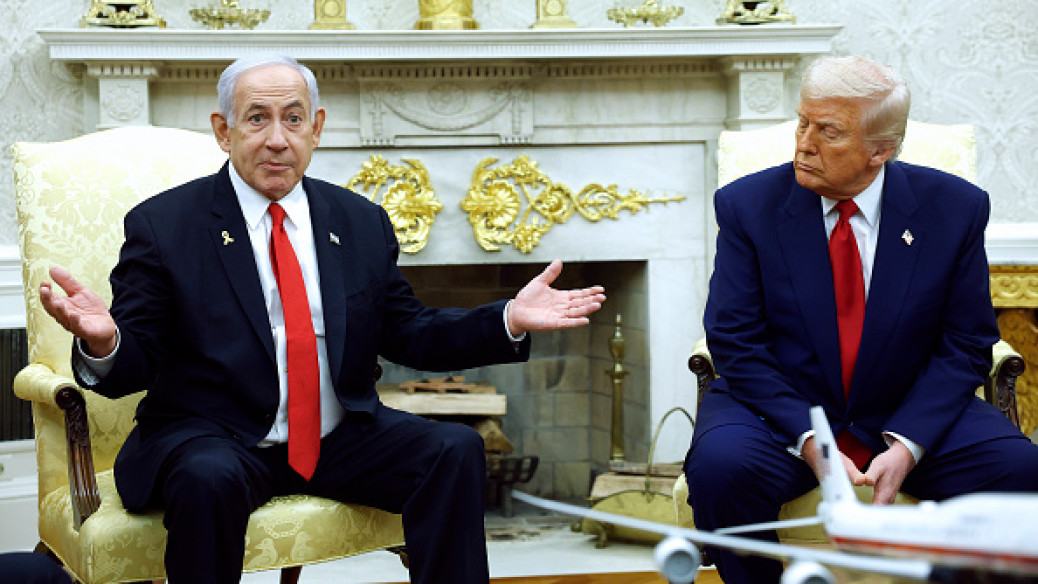 Did the midterms deal a death blow to Trump and Netanyahu's political careers?
By Mounir Rabih
BEIRUT, 08 Nov. - (ANA) - The outcome of the US midterm elections reflects a deeper movement in American political history. What makes this result particularly significant is its timing, coming after the crises, wars and policies pursued by Donald Trump during his second term.
It is true that many previous US presidents have entered the second half of their terms after losing control of Congress. This time, however, the consequences could be far more profound, not only for domestic American politics, but for the wider Western world, the international order and, above all, Israel.
Within hours of the results, a number of American voices were already arguing that Washington’s relationship with Israel, and its unconditional support for it, had become one of the factors behind the Republican defeat.
That cannot be separated from a much broader shift taking place across the West, particularly in Europe, but also within American public opinion. The change is especially visible among younger voters, who made their political preferences clear at the ballot box.
There is something here that could shape the future: the possibility of a correction in the historical trajectory of the West.
Western societies have increasingly struggled to accept Israel’s war in Gaza and the mass killing there, or the systems of separation, displacement and exclusion Israel has pursued not only in Palestine but elsewhere in the region, particularly Syria and Lebanon. There is also growing rejection of an apartheid mentality that has shaped Israeli politics and that some have sought to reproduce in the United States and beyond.
The paradox is that Western societies, because their political systems allow voters to hold governments accountable, retain a capacity for self-correction. Similar shifts have been visible elsewhere, from Brazil to other countries where right-wing movements have suffered electoral defeats.
These US elections could form part of the same process.
The American idea has always rested on the claim that the country can embrace people from different backgrounds and offer them opportunity. Its political system cannot indefinitely become the opposite of the values and constitutional principles it claims to represent.
America cannot isolate itself from the world, nor isolate the world from itself. Nor can it sustain increasingly racialised forms of exclusion at home.
Neither can the country be reduced to one man, or its foreign policy tied so closely to a single state, particularly one such as Israel, whose policies have generated conflict with much of the world.
What happened in these elections therefore represents, in practical terms, a defeat for Trump’s personal political project and a victory for constitutional institutions, regardless of the policies those institutions ultimately pursue.
It could also mark the beginning of the end of Trumpism as a global political model.
Trump’s temperament and his approach to government and international relations were always difficult to reconcile with the political and moral systems of many of the countries he dealt with, including those whose values he himself often invoked.
Part of the price paid by the Republican Party was therefore the price of Trump’s own behaviour: his treatment of traditional US allies, particularly Europe, his contribution to destabilising the existing international order, and his personal ambition to divide the world among a handful of powerful leaders, particularly Russia’s Vladimir Putin and China’s Xi Jinping.
The defeat of Trump’s personal project does not, however, mean the disappearance of Trumpism. Its influence will remain deeply embedded within the Republican Party and within the wider American populist right.
Nor can what happened in the United States be separated from developments in Europe, where left-wing movements, migrant communities and younger voters have increasingly confronted the conservative and far right.
Similar dynamics are now visible in America. The values and political instincts of the American public cannot remain entirely detached from those taking shape in Europe.
There is also growing resistance to Trump’s vision of a world divided between great powers, in which Washington reaches understandings with Russia and China at the expense of smaller states, their interests, and the historical ties underpinning the transatlantic relationship.
The election results also point to a major political and demographic shift in the United States.
Young voters made up a significant share of the electorate, and most backed the Democrats. They are also the future of American politics. At the very least, their political attitudes are likely to influence the country for another two or three decades.
That makes this generation particularly important for the future relationship between East and West.
Younger Americans have shown greater opposition to war, greater sympathy towards migrants, and greater engagement with the issues of the Middle East.
They were the students and young activists who led demonstrations against Israel’s war in Gaza, mobilising broader sections of public opinion against the systematic killing there and against Washington’s unconditional support for Israel.
It is from this generation that figures such as Zohran Mamdani and Abdul El-Sayed have emerged, reflecting a political current that preserves the diversity and pluralism the West, and particularly the United States, has long claimed as one of its strengths.
As Azmi Bishara has argued, people from these backgrounds may also prove central to rescuing the political and moral future of the West from the consequences of isolationism and racism.
The same racial politics could be seen in Israel’s reaction to the election results and to high turnout among Arab voters.
Israeli figures went as far as accusing Qatar and Azmi Bishara of encouraging greater Arab participation in the elections. Israeli authorities then detained journalist Abed Abu Shehadeh after he visited Qatar and interviewed Bishara, treating the interview as part of an effort to encourage Arabs to vote in large numbers.
Trump has deployed a similar logic against migrants in the United States, often in explicitly racialised terms, alongside his continuing confrontation with media organisations that do not support him.
This is where Bishara’s argument becomes particularly relevant: “Israel losing its dominance over the discourse in the West is the most important transformation that must be preserved. The wave of solidarity must be turned from humanitarian solidarity with the victims and revulsion at Israeli brutality into political solidarity that does not stop at a plan to end the war which incorporates all Israeli conditions without a just solution to the question of Palestine.”
That is where the real political battle now lies: in continuing to shift Western public opinion not only on Palestine, but on Arab issues more broadly.
The biggest loser from the US election results may ultimately be Benjamin Netanyahu, and behind him Israel itself.
The consequences may not be immediate, but the foundations of a longer-term shift are already being laid. They can be seen in the growing debate in the United States over its relationship with Israel, in Trump’s own announcement that annual US support would be cancelled, and in the pressure on AIPAC, the powerful pro-Israel lobby, to scale back public support for candidates who increasingly see open association with the organisation as an electoral liability.
The results will also have consequences inside Israel, particularly over the medium and long term.
In the short term, however, much will depend on Netanyahu’s political fate: whether he succeeds in securing a mandate to form the next government, or whether Gadi Eisenkot manages to build an alternative coalition if given the opportunity.
Either outcome could mark the beginning of further political change.
The US midterm results will also raise difficult questions about how Trump governs from this point onwards.
He entered office with a strategic project centred on asserting American control over major energy sources and transport routes. He still wants to pursue that agenda, yet at home he has failed to bring down fuel prices.
Those prices have fed domestic economic pressures, contributed to inflation and had a tangible impact on voting behaviour, alongside growing public resistance to a return to an era of permanent war.
Bringing fuel prices down will leave Trump with a pressing need to reopen the Strait of Hormuz.
That would require either an agreement or a major military operation capable of reopening it by force.
But even if Trump wants to renew the war with Iran, no US administration can easily undertake such a conflict alone. Washington would need partners, and the first and most important of those would be Israel.
That brings the calculation back to Netanyahu.
Of all the leaders involved, Netanyahu has the greatest incentive to move quickly towards another war and secure what he would present as a decisive achievement against Iran.
That makes the situation particularly difficult to predict.
Both Trump and Netanyahu are under political pressure. Both may be tempted to use escalation abroad as a way out of difficulties at home, particularly before Netanyahu’s own political future, and whether he remains prime minister, is finally decided. - (ANA) -
AB/ANA/08 November 2026 - - -
|