[Published: Friday March 20 2026]
 ‘Bigger than some armies’: Kyiv warns of 27,000 foreign fighters on Russia’s side
By Nikolaj Nielsen
BRUSSELS, 20 March. - (ANA) - Over 27,000 people from other countries were recruited to help fight Russia’s war in Ukraine, according to Ukrainian authorities.
“This number is larger than some armed forces in some of the European countries,” said Andriy Yusov, a Ukrainian intelligence spokesperson.
Speaking to European lawmakers on Wednesday (18 March), Yusov said the numbers have been increasing year-on-year.
In 2023, Russia enlisted 3,808 foreign fighters, followed by 8,265 in 2024 and almost 14,000 last year, he said.
Most of them are sourced from post-Soviet states such as Azerbaijan, Belarus, Tajikistan and Uzbekistan.
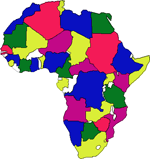
But more recent recruits are also being sourced from Africa and South America, in particular Ghana, Kenya, Mali, Nigeria and Brazil.
Many are said to be deceived into fighting and sent to the frontline through what experts describe as a predatory recruitment.
“For the Russians, these are ideal soldiers, because their death will not cause any concern in Russia,” said Yusov.
Around 1,800 are said to be African nationals, sourced from some 36 states.
A joint intelligence report presented to the Kenyan parliament said roughly 1,000 Kenyans had been recruited or lured as of February.
“Just yesterday, Kenya’s cabinet secretary for foreign affairs revised the figures, now putting the number at 252,” says Rosemary Tollo, a Kenyan journalist.
Tollo, who has been documenting African prisoners of war since 2024, says a semi-formal labour recruitment network operates in Kenya, sending workers to jobs abroad.
Some recruits were aware they were being sent to join the Russian army, she said, but others were deceived about their destination and purpose.
“Recruits are typically promised bonuses of around $2,000 [€1,737]and the prospect of Russian citizenship,” she said, noting people earn roughly $200 at home.
Those overseeing the recruitment process can reportedly earn as much as $15,000 for each person they enlist.
Once in Russia, many recruits reported finding themselves in conditions that made it nearly impossible to leave. Their passports were confiscated upon arrival, she said.
Money cannot replace a child
Many travelled to Russia believing they would be able to send money home through Russian bank accounts despite the fact that, under heavy international sanctions, those banks are now cut off from the SWIFT system.
Contracts were provided only in Russian, and even when translated, many recruits said they struggled to understand the terms they had signed, said Tollo.
Among them is 31-year old Charles Waithaka, a Kenyan national who was duped into fighting for the Russian Federation.
His mother Bibiana says Charles says Charles, a trained mechanic with no military experience, was lured to Russia under false pretences. “He was deceived with fake promises of employment,” she says, recalling how his visa and travel documents were processed in less than six hours.
According to Bibiana, Charles had been told he would work as a plant mechanic, while the recruiter who arranged the trip pocketed a €1,000 commission.
He ended up on the front line in Ukraine after being forced to sign a contract he didn’t understand, she says.
She last heard from him on 27 December last year until she learned of his death on social media a month later.
“I believe there must be recognition and accountability for what happened to him. No amount of money can replace a child,” she said. - (ANA) -
AB/ANA/20 March 2026 - - -
|





 Eurojust/Labour Trafficking